Previously: Over four parts we have dismantled the case for both the centralized Data Warehouse and the over-engineered Data Mesh, argued for small business-embedded domain teams as the only structure that satisfies the conditions of strong ownership, shown how Qlik Cloud Analytics removes the platform ceiling that forces teams to grow, and demonstrated how Parquet and open standards ensure that starting fast does not mean staying trapped. One piece remains: how do fast, autonomous domain teams stay trustworthy participants in the enterprise data ecosystem without reverting to the governance bureaucracy they were trying to escape?
Written by GOODIN BI Lead Phuoc Tran Minh

Here is the scenario that has been waiting in the background of this entire series.
During a CRM version upgrade over a long weekend, the customer service team consolidates their churn reason codes. What were previously two distinct values, “price sensitivity” and “competitive loss,” get merged into a single value. The change is deliberate and well-reasoned from a CRM administration perspective: the two categories had been inconsistently applied by different regional teams for years, and the migration is the right moment to clean it up.
The Parquet file exported by the Customer Service domain team on Monday morning looks identical to the previous week. Same schema. Same row counts. Same field types. No nulls in critical fields. Every stop-the-line assertion passes. Every automated quality check is green. The data is technically perfect.
But the Sales leadership team’s churn analysis now shows competitive losses have effectively doubled while price sensitivity has disappeared entirely from the dashboard. Over the following three weeks, leadership commissions an urgent competitor analysis and pricing review, preparing for a workshop to formulate new go-to-market and product development strategies to be presented in the next board meeting.
The root cause surfaces only when a CRM specialist mentions in passing that the reason codes changed in the version upgrade. No automated system could have detected it. The data was correct by every technical measure. What changed was meaning, and meaning lives in the heads of the people who use the data, not in the schema. Three weeks of misdirected strategic effort are not recoverable.
The most expensive data failures are not the ones that break the pipeline. They are the ones that let it run perfectly while feeding the wrong story to the people making decisions.
The traditional enterprise response is to buy expensive data cataloging software, enforce rigid data contracts, and build automated lineage tracking pipelines. In other words, to solve a human coordination problem with an engineering solution, adding exactly the kind of complexity that caused the Data Mesh to collapse under its own weight in Part 1.
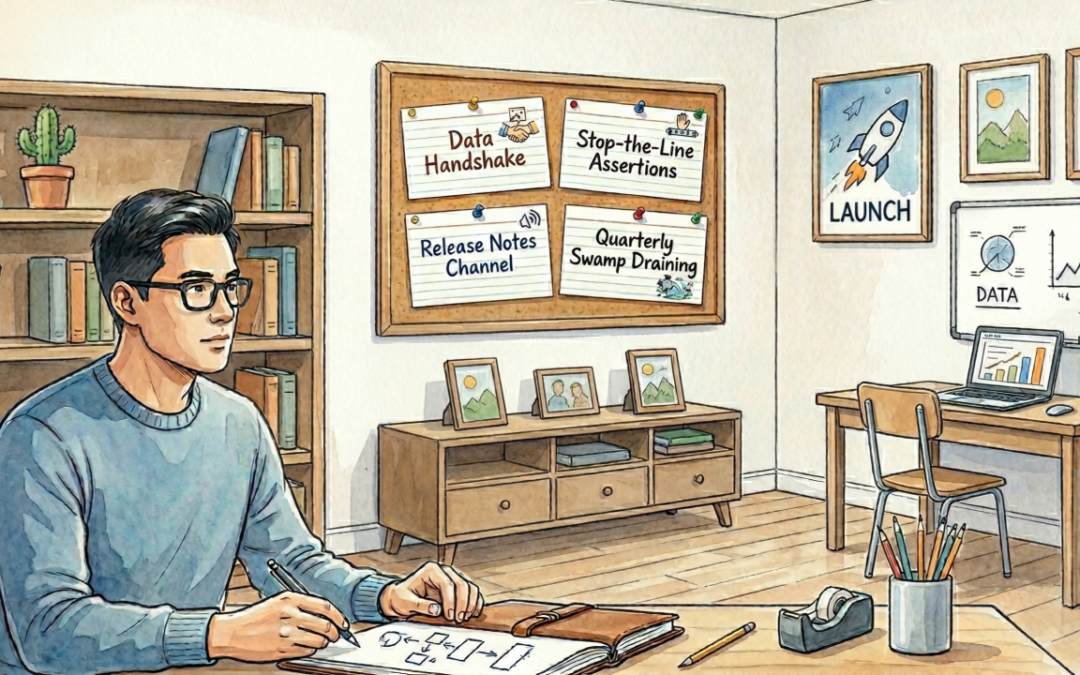
The Pragmatic Mesh takes a different position. Fast, autonomous teams do not need more software or process gates. They need lightweight social contracts: shared expectations, clear accountability, and a small number of habitual practices that prevent the most common failure modes without slowing anyone down. We call these lean governance rituals. There are four of them, and any team can implement all four by next Monday.
Ritual 1: The One-Page Data Handshake
Before a domain team shares a dataset with another team, they write a single page. Not a formal specification. Not a forty-field entry in an enterprise data catalog. A page. It lives in whatever shared documentation tool the organization already uses: Confluence, Notion, a Teams channel, a shared drive. It covers exactly four things.
The four things a Data Handshake must answer:
Owner: The specific human being, not a team inbox, who is the first call if something looks wrong.
Cadence: When is this dataset updated? Daily by 8am? Real-time every 15 minutes? The consumer needs to know when to worry if it has not arrived.
Grain and meaning: What does one row represent, and what do the key classification fields mean in this business context? The reason code scenario above would have been prevented by a single sentence here: “Churn reason codes follow the classification scheme defined in the CRM migration document dated [date]. Any changes to this classification will be communicated two weeks in advance.”
Schema and semantic lock: A commitment that core column names, types, meanings, and business classifications will not change without two weeks’ notice to all known consumers. Not a legal contract but a personal and professional commitment by the owner.
Whatever documentation platform you use, it should have one specific capability: automated notifications. Consumers of a dataset subscribe to its Data Handshake page and receive an automatic alert any time it is updated. This is a pull model, not a push model — people subscribe to the datasets they actually consume, rather than receiving every update from every domain team. That distinction matters because broadcast fatigue is a real failure mode: if every change goes to everyone, people stop reading.
The subscription notification is the safety net. When a domain team updates the Data Handshake page, subscribed consumers are alerted automatically. The team should also broadcast the change to the release notes channel described in Ritual 3 for the benefit of consumers who have not yet subscribed. Together, these two layers cover both the known and the overlooked consumers of every shared dataset.
Ritual 2: Stop-the-Line Assertions
In lean manufacturing, stopping the production line the moment a defect is detected is a foundational quality principle. Data pipelines need the same instinct. A domain team using Qlik can embed simple validation checks directly into the load script, before the export to Parquet runs. These are not sophisticated testing frameworks.
They are basic sanity checks that catch the technical failure modes that happen most often.
Practical stop-the-line checks to build into every load script:
Duplicate primary keys in the output? Abort and alert.
Row count more than 20% lower than yesterday’s run? Abort and alert.
Key metric negative or zero when it should not be? Abort and alert.
Null values in fields that should never be null? Abort and alert.
The core principle is deliberate failure over silent corruption. It is always better for a downstream consumer to receive data that is 24 hours old than data that is quietly wrong. An alert that says the pipeline did not run is immediately actionable. A pipeline that ran and produced corrupted output can contaminate decisions for days before anyone notices.
Crucially, these checks catch technical failures. They would not have caught the reason code scenario, which passed every technical check perfectly. That is precisely why the semantic commitments in Ritual 1 and the human communication in Ritual 3 exist alongside them. No automated check validates meaning. These rituals work as a system.
When Tooling Makes Governance Easier, Not Heavier
Qlik Cloud Analytics now includes AI-assisted data quality rules that complement stop-the-line assertions without replacing them. Rather than writing validation logic manually, a team member describes the intent to Qlik’s Discovery Agent which will then proactively raise red flags when it detects potential anomalies. No specialist skills required, no ongoing maintenance overhead. Qlik’s Trust Score feature extends this further, giving downstream consumers a quantified quality signal based on completeness, freshness, and consistency, without requiring anyone to design a quality framework from scratch.
Similar AI-assisted quality tools will proliferate across the industry. They are worth adopting when they reduce cognitive load and keep processes simpler for the team. They are worth ignoring when they require dedicated configuration, specialist maintenance, or create their own process overhead. The test is always the same: does this tool help the small team stay small and focused on the business, or does it give the team a new system to manage?
Good tooling is governance that runs itself.
Ritual 3: The Release Notes Channel
The most expensive data failures are caused by silent semantic changes. A metric calculation is updated. A classification scheme is consolidated during a system migration. A date filter or lead-time calculation shifts from shipment creation to pickup date. Each change is correct and intentional from the domain team’s perspective. None of them are visible to the teams depending on the data, unless someone says something.
The fix is a single shared channel, a dedicated Slack or Teams channel called something like #data-updates, where any domain team about to make a meaningful change to a shared dataset posts a brief note. Not a ticket. Not a change request. A message.
Example message:
“Hey everyone — following our CRM migration this weekend, we have consolidated the churn reason codes. ‘Price sensitivity’ and ‘competitive loss’ are now a single code. If you use churn reason in your dashboards or models, please check whether this affects your logic. The updated classification is in the Data Handshake page. Happy to answer questions.”
That message takes two minutes to write. It would have saved three weeks of misdirected strategic effort in the scenario above. The channel also serves as a lightweight audit trail: when an analyst notices an unexpected shift in a metric weeks later, they can search the channel and find the explanation without opening a ticket or scheduling a meeting. The combination of automated subscription notifications from Ritual 1 and this broadcast channel creates two layers of communication, covering both the consumers who subscribed and those who did not yet know they needed to.
Ritual 4: The Quarterly Swamp Draining
When exporting data is as easy as adding one line to a load script, shared storage accumulates quickly. Old project exports never deleted. Experimental datasets that became permanent by accident. Three versions of the same customer table from three different points in a migration. Over time the shared space becomes a swamp: technically navigable, practically confusing, and quietly corrosive to the confidence downstream teams have in the data they find there.
Once a quarter, get the domain data owners together for a thirty-minute meeting with one agenda item: look at the shared storage and remove anything that is not actively maintained and consumed.
The decision rule:
Not updated, accessed, or queried in 90 days: archive to cold storage with a clear label, or delete.
Nobody in the room knows who owns it or what it contains: delete.
Name does not clearly indicate what it is, when it was created, and who owns it: rename before the meeting ends.
Swamp draining is the governance ritual that feels least like governance. But it forces a regular conversation between domain owners about what data actually exists, who is responsible for it, and whether it is still worth maintaining. Teams that know what each other are publishing coordinate without being forced to. That awareness, renewed every quarter, is one of the most effective defenses against the silent semantic drift that causes the failures described at the start of this part.
Governance as Culture, Not a Control Process
Four rituals. One page of documentation per shared dataset. A few lines of validation code in each load script. A two-minute message when something meaningful changes. A thirty-minute meeting once a quarter. That is the foundational governance framework for the Pragmatic Mesh.
The reason it works is not technical sophistication. It is proportionality. The vast majority of costly data failures are basic communication failures: someone changed the meaning of something without telling anyone, someone did not know what a classification field represented, someone could not find the right version of the data. These are human problems, and they respond to human solutions.
The heavy enterprise approach to governance makes it technically difficult to cause these problems. The lean governance approach makes it culturally normal not to. The heavy approach requires ongoing maintenance, license fees, and specialist knowledge. The lean approach requires only a shared commitment to a small number of intuitive habits. Build the culture of accountability first. Buy the software only when you genuinely have to, and only when it makes the process simpler rather than adding a new one.
Good governance is not primarily about rules but about people who feel personally responsible for the quality of what they publish.
The One Thing That Will Undo All of This
There is a warning that belongs at the end of this series, because it describes what happens to well-designed small teams if they are not vigilant: the complexity will grow back.
Complexity accumulates naturally in any successful system. A domain team ships a working pipeline. Another team depends on it. A third depends on the second. An edge case requires a new field. A regulatory requirement demands an audit log. A new tool is added for a specific problem. Each individual addition is reasonable. Collectively, they erode the conditions for strong ownership more reliably than any organizational restructuring.
As complexity grows, authority weakens because more stakeholders are required for every decision. Understanding fragments because no single person can hold the full picture anymore. Motivation drains because the work becomes about managing the complexity rather than serving the business. The small team that was shipping insights in days starts opening tickets, waiting for approvals, and writing documentation nobody reads. The backlog appears. Then the specialist roles to manage the backlog. Then the processes to coordinate the specialists. The centralized data team has reconstituted itself, this time inside the domain.
The defense is active, not passive. It requires deliberately minimizing dependencies between domains, preferring integrated tools over best-of-breed stacks that need orchestration, choosing free-form collaboration over rigid JIRA workflows/approval chains for routine work, and treating every addition to the team’s technical surface area as a cost to justify rather than a capability to acquire. Simplicity is not the default state of a growing system. It is the result of consistent, intentional resistance to the forces that undermine it.
The Pragmatic Mesh is not a one-time implementation. It is an ongoing discipline of keeping things simple enough that a small team can own them completely and feel personally accountable for every part of what they have built.
Accumulating complexity is how strong personal ownership dies quietly. Every unnecessary dependency, every approval step, every new tool that requires its own specialist is a transfer of ownership away from the team that was supposed to have it.
Where We Started, and Where We Have Arrived
In Part 1, we described a pattern that plays out repeatedly in large organizations. They build the centralized Data Warehouse. It arrives late, costs more than planned, and becomes a bottleneck the moment it goes live. The business loses patience and builds its own analytics in the shadows. The organization ends up with both problems simultaneously: a stagnating warehouse they cannot retire and a self-service sprawl they cannot govern. When it fails, it is always the technology or the consultant gets the blame, never the centralized model.
Data Mesh was meant to fix this by returning ownership to the business. In practice, it replaced one form of complexity with another, asking business analysts to become software engineers as the price of autonomy. The failure rate speaks for itself.
The Pragmatic Mesh starts from the observation that the root problem was never technical. It was motivational and organizational. People without authority, understanding, or a visible connection to the impact of their work do not take ownership, regardless of what the org chart says. Daniel Pink described this at the level of individual motivation. It applies with equal force to how data teams are structured.
The model this series has argued for is not complicated. Small teams embedded in business domains, with dedicated developers who stay long enough to develop real understanding. A platform that keeps the full stack manageable for a single capable person. Open standards for output so local speed does not create enterprise silos. Lightweight social contracts based on personal commitment instead of compliance theater. Active vigilance against the accumulating complexity that will quietly dismantle everything if left unchecked.
None of this is radical. The best software product teams have operated this way for years. The data industry has simply been slow to catch up, distracted by the promise of each successive architectural silver bullet. The warehouse did not fix the ownership problem. The lake did not fix it. The mesh did not fix it. The Pragmatic Mesh does not fix it either, because no architecture can. What architecture can do is stop making the problem worse, and give the people doing the work the conditions they need to solve it themselves.
The competitive advantage in data does not come from the most sophisticated architecture. It comes from empowered, motivated people who understand their domain, own their pipeline end to end, and feel personally accountable for what they produce.
The warehouse that arrived 18 months late and became a bottleneck was not a technology failure. It was a structure that guaranteed the wrong people would own the wrong decisions with no skin in the outcome. Fix the structure, choose the right platform, build the social contracts, and defend simplicity like the strategic asset it is.
That is what the Pragmatic Mesh is. Not a product. Not an architecture. A set of conditions under which strong personal ownership of data becomes possible, and where the people closest to the business problem are also the people with the authority, the tools, and the motivation to solve it.
THE PRAGMATIC MESH SERIES: A SUMMARY
Part 1: The Data Warehouse fails because it centralizes ownership. The Data Mesh fails because it confuses organizational autonomy with infrastructure engineering. Most organizations end up with both problems simultaneously.
Part 2: Strong ownership requires authority, understanding, and motivation — Pink’s autonomy, mastery, and purpose applied structurally. Small, business-embedded teams with dedicated developers are the only structure that satisfies all three. Co-creation builds the relatedness that makes the work worth doing.
Part 3: The platform is the team size constraint. Qlik Cloud Analytics enables full-stack development by a single capable person, with fast feedback loops, transparent load script logic, and no infrastructure overhead. One well-designed associative model replaces dozens of fragmented point-solution reports.
Part 4: Starting fast does not mean staying trapped. Parquet, the Data Products REST API, and Apache Iceberg provide a clear maturity path from domain-level iteration to enterprise lakehouse architecture. Qlik Talend Cloud is the natural extension for complex data integration at scale.
Part 5: Fast, autonomous teams stay reliable through four lightweight social contracts: the Data Handshake, Stop-the-Line Assertions, the Release Notes Channel, and the Quarterly Swamp Draining. Governance as culture, not compliance, and active resistance to accumulating bureaucracy and complexity that quietly weakens personal ownership.
Most data initiatives fail for the same reason: nobody owned it personally enough to make it succeed. No architecture fixes that. What you need is the right structure, platform, and culture: the Pragmatic Mesh.